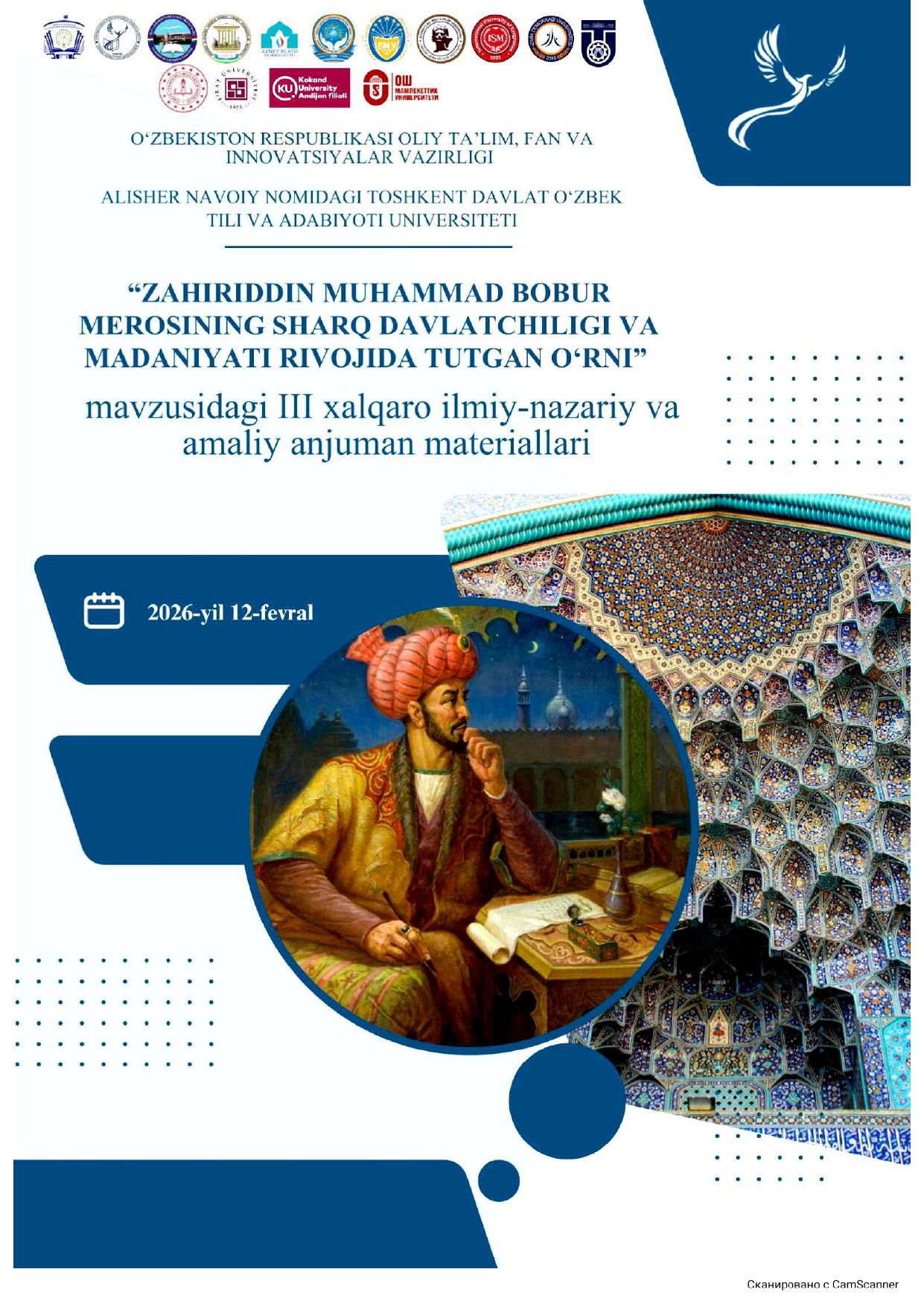
“BOBURNOMA”DA DINIY LEKSIKANING LEKSIK-SEMANTIK VA FUNKSIONAL XUSUSIYATLARI
Keywords:
religious lexicon, lexico-semantic feature, functional feature, “Baburnama”, Zahiriddin Muhammad Babur, Arabism, linguistic analysis, semantic expansionAbstract
Zahiriddin Muhammad Babur's “Baburnama” is a unique monument of Uzbek literature and linguistics. This article provides a detailed analysis of the lexico-semantic features and functional usage of religious terms such as “xudo”, “alloh”, “payg‘ambar”, “masjid”, “namoz”, “ro‘za”, “Qur’on” and “hadis” in the work. The religious lexicon is mainly borrowed from Arabic and Persian languages and is used in historical events, personal experiences, cultural and political contexts. The study employs lexico-semantic methods, including component analysis and contextual analysis. The results demonstrate the semantic expansion, metaphorical usage, and narrative functions of religious vocabulary.
Downloads
Published
2026-04-01