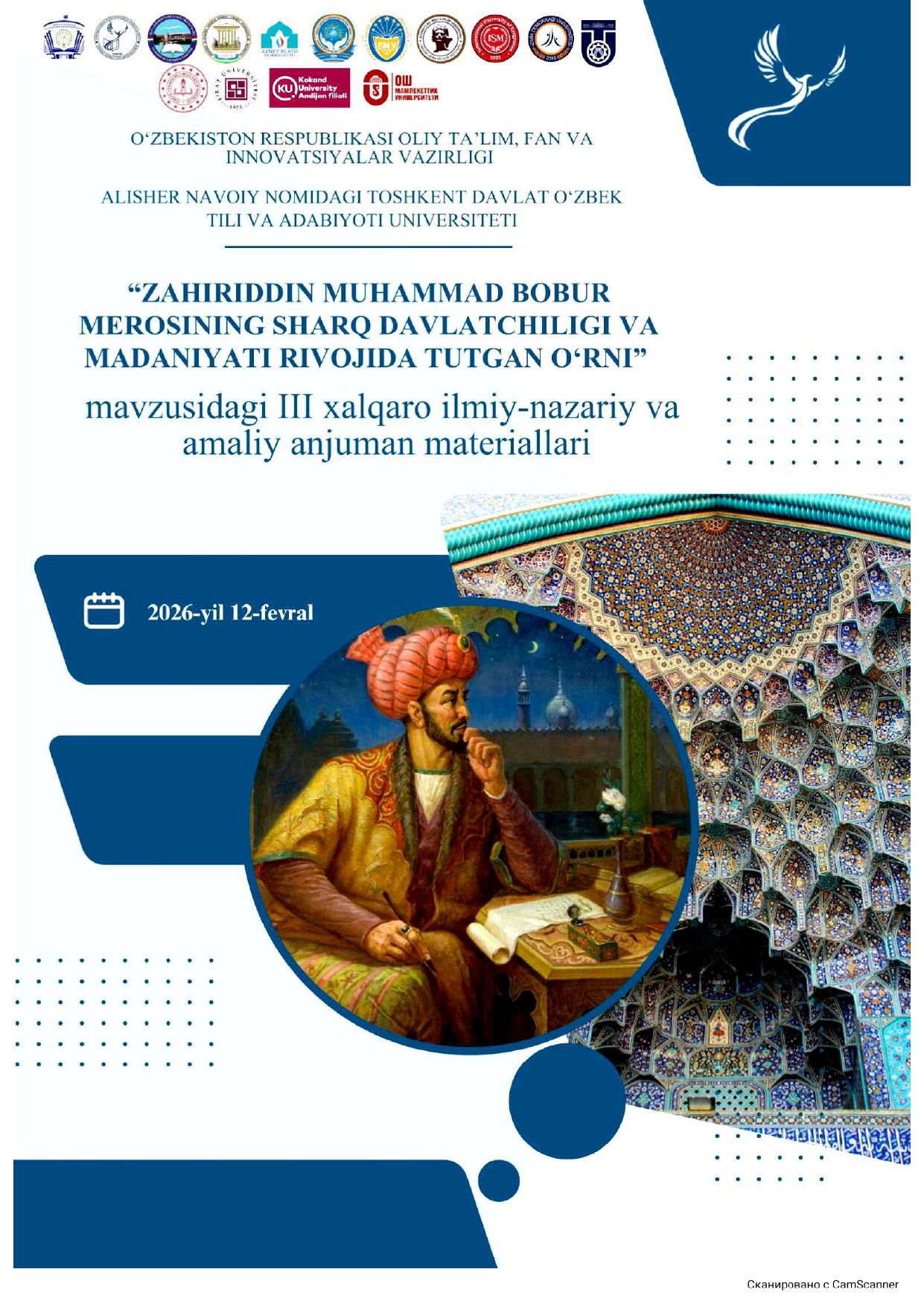
LITERARY-LINGUISTIC AND HISTORICAL-SOCIOLOGICAL INTERPRETATIONS OF “BABURNAMA”
Keywords:
Babur, Chagatai Turkic, literary-linguistic analysis, historicalsociological analysis, autobiography, medieval Central Asia, socio-cultural identity, language contactAbstract
This article examines the Baburnama by Zahir-ud-din Muhammad Babur from literary-linguistic and historical-sociological perspectives. As an autobiographical chronicle written in Chagatai Turkic, the Baburnama occupies a distinctive position at the intersection of literature, linguistics, and history. The study aims to identify the narrative, stylistic, and linguistic features of the text and to analyze its value as a source for reconstructing the social, political, and cultural realities of the late fifteenth and early sixteenth centuries. The research is based on interdisciplinary methods, including literary analysis, linguistic examination, and historical-sociological interpretation. The findings demonstrate that the Baburnama combines expressive literary form with detailed documentation of governance, social hierarchy, military organization, and everyday life. The results highlight the significance of language contact, cultural interaction, and authorial subjectivity in shaping the narrative. The article concludes that the Baburnama should be regarded not only as a literary masterpiece but also as an important source of sociolinguistic and historical data, contributing to the study of cultural memory and identity in the medieval Turkic and Indo-Persian world